
 | marketing@wsdks.com |  | +8617712621386 |  | No. 8 Jinwei Road, Changshu City, Jiangsu Province, P.R.China |


Zero Liquid Discharge (ZLD) System: Technology, Process, and Real Industrial Results
Zero liquid discharge — ZLD — has moved from an aspirationalsustainability target to a regulatory requirement for an expanding list ofindustries. Whether driven by outright discharge bans, water scarcity in aridregions, or the prohibitive cost of traditional wastewater disposal, moreindustrial plants are implementing ZLD systems each year. This article explainshow modern ZLD technology works, describes the equipment that makes itpossible, and presents verified results from actual ZLD projects delivered byVIFLUTER.
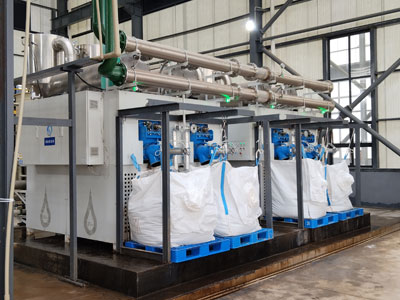
What Is Zero Liquid Discharge?
A zero liquid discharge system treats industrial wastewater tothe point where all recoverable water is reclaimed as clean distillate forreuse, and the only waste output is a dry solid — crystallized salts, dewateredsludge, or both. No liquid effluent leaves the facility. The ZLD system closesthe water loop entirely, transforming a disposal cost into a water recoveryasset.
ZLD is most commonly required for high-salinity industrialwastewater that cannot be economically treated to conventional dischargestandards, or for facilities in water-stressed regions where any liquiddischarge is prohibited.
The ZLD Plant Process: Three Stages
Stage 1 — Pre-treatment andPrimary Concentration
Raw wastewater is pre-treated to remove suspended solids, oils,and scaling precursors (hardness, silica) that would foul downstream equipment.The pretreated water then enters the concentration stage, where a vacuum heatpump evaporator or MVR system reduces the water volume by 90%–97%, producingclean distillate and a concentrated brine. VIFLUTER's vacuum heat pumpevaporators achieve this at operating temperatures of 40°C–50°C — low enough tominimize scaling even in high-hardness feedwater — with COP values of 9–10 forexcellent energy efficiency.
Stage 2 — Crystallization
The concentrated brine from Stage 1 is fed into a crystallizer.VIFLUTER's Vacuum Heat Pump Crystallizer, operating at 35°C–50°C with abuilt-in spiral agitation system, drives the brine past its saturation point,precipitating dissolved salts as solid crystals. The crystallizer's steamspiral filtration system removes over 95% of free organic matter from thevapor, and its COD reduction in discharged water is 70% better thanconventional vacuum evaporators — a critical advantage when distillate qualitymust be maximized. For ultra-high-concentration mixed-salt mother liquors, theVacuum Steam Crystallizer operates at approximately −95 kPa with a scraper-typestructure for continuous solid discharge.
Stage 3 — Solid Handling andDrying
Crystallized solids are dewatered and passed to a lowtemperature dehydrator for final drying to moisture content ≤ 8%–10%.VIFLUTER's closed-loop heat pump drying circuit operates at 40°C–60°C,producing a stable, low-moisture solid that is safe for storage, transport, andlandfill disposal — or, in some cases, suitable for direct sale as a recoveredsalt product.
Verified ZLD Results from Industrial Projects
Pesticide IntermediateManufacturer — High-Salt Wastewater (NaCl + Na₂SO₄):
· Previous process: three-effect evaporation mother liquorre-injected to ground — caused treatment capacity loss, increased energy cost,frequent scaling and pipe blockage.
· After VIFLUTER ZLD system: Hazardous waste reduced by 70%.Disposal cost decreased by 50%. Concentrate moisture content ≤ 10%.
Oil and Gas Extraction —High-Salt Produced Water (Na₂SO₄ + NaCl):
· Previous process: long process flow, poor stability, highoperator skill requirements, high chemical dosage.
· After VIFLUTER ZLD system: Hazardous waste reduced by 70%.Disposal cost decreased by 50%. Concentrate moisture content ≤ 10%.
Mining and Smelting —High-Salinity Wastewater:
· Customer goal: maximize industrial water recycling rate; ZLD ofmixed salt mother liquor was the most difficult step.
· After VIFLUTER ZLD system: Mixed salt mother liquor dryingefficiency increased by more than 3×. Energy consumption reduced by more than50%. Moisture content ≤ 10%.
Ethane-to-Ethylene Plant — MixedSalt Mother Liquor:
· Before: COD 15,000 mg/L, TDS 150,000 mg/L, Ammonia nitrogen 120mg/L.
· After: COD 32 mg/L, TDS 350 mg/L, Ammonia nitrogen 25 mg/L.Moisture content 12%. Drying efficiency improved by 3×.
Is ZLD Economically Viable for Your Facility?
ZLD systems require capital investment in evaporation,crystallization, and drying equipment. The economic case is strongest when oneor more of the following apply:
· Mandatory zero-discharge regulation: ZLD is the only path tocompliance.
· High hazardous waste disposal costs: Projects where VIFLUTERsystems reduced disposal cost by 50% paid back the investment in 2–4 years.
· Water scarcity: Distillate recovery reduces freshwater intake —a tangible operating cost saving in water-stressed regions.
· High-volume saline wastewater: MVR and heat pump evaporationbecome increasingly cost-competitive at volumes above 5 T/day.
Conclusion
Zero liquid discharge is no longer a future technology — it is adeployed reality in pesticide manufacturing, oil and gas, mining, coalchemicals, battery production, and surface treatment. VIFLUTER's integrated ZLDsystems — combining vacuum heat pump evaporation at 40°C–50°C, vacuumcrystallization with COP 9–10, and closed-loop low temperature drying — deliververified hazardous waste reductions of 70%, energy savings of 50%+, andconcentrate moisture contents as low as 8%.
If your facility faces discharge restrictions, rising disposalcosts, or water recycling targets, contact VIFLUTER for a ZLD feasibilityassessment and preliminary system design tailored to your wastewatercharacteristics and regulatory requirements.