
 | marketing@wsdks.com |  | +8617712621386 |  | No. 8 Jinwei Road, Changshu City, Jiangsu Province, P.R.China |


How Does a Vacuum Evaporator Work? Step-by-Step Process
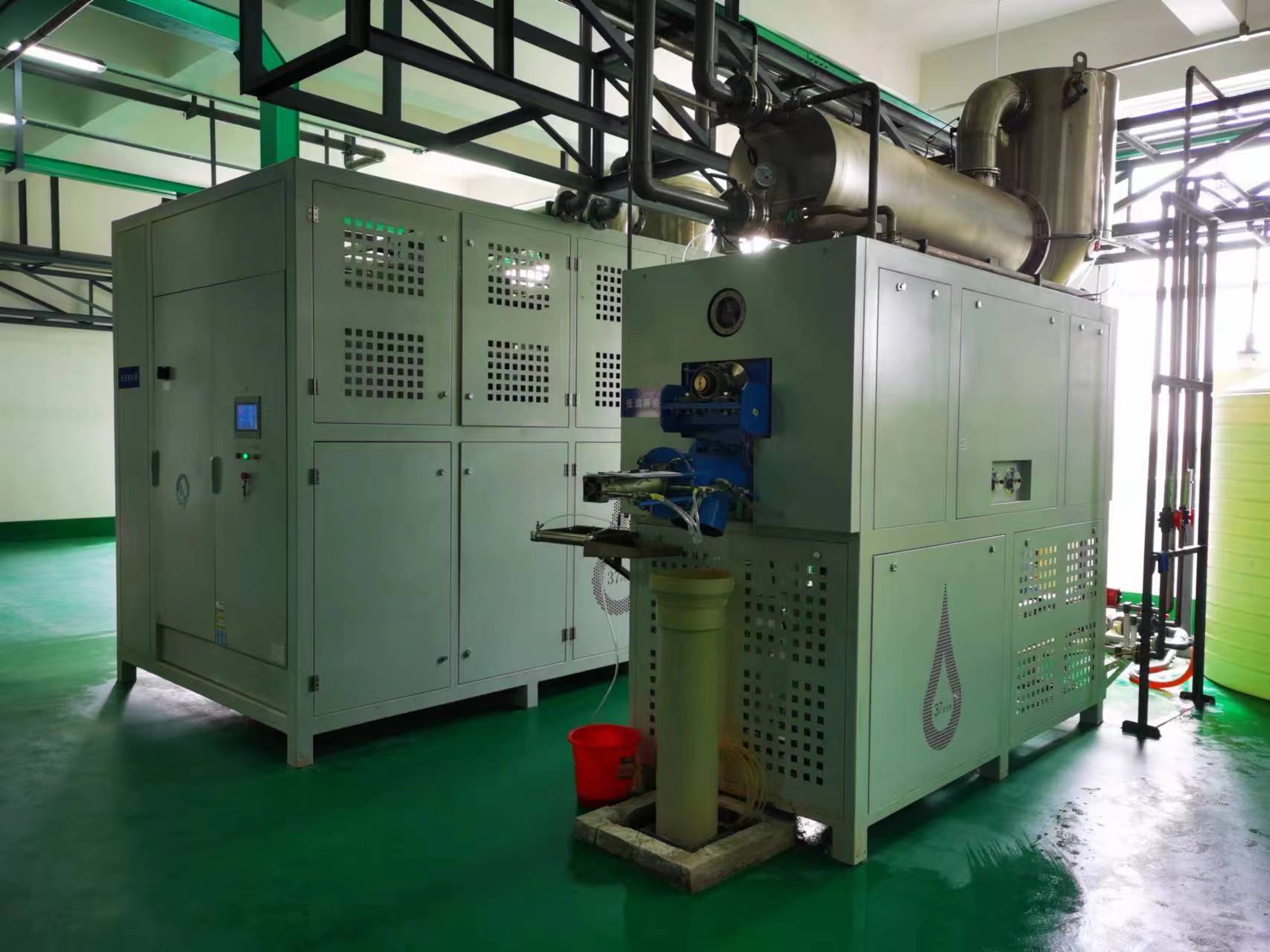
A vacuum evaporator looks deceptively simple from the outside — askid with tanks, a compressor, some pumps. Inside, five distinct physical stepshappen in sequence, and understanding each one is the difference betweenreliable operation and constant fouling headaches.
Step 1: Feed Preheating — Don't Shock the System
Wastewater enters the system at ambient temperature and firstpasses through a plate heat exchanger. Here, it's preheated to 35-40°C by theoutgoing hot condensate and concentrated brine. This is not optional. Cold feedhitting a 45°C evaporator tank causes thermal shock, uneven boiling, and scalenucleation on tube surfaces.
VIFLUTER's FC series runs a dedicated preheating circuit thatrecovers 60-70% of latent heat, cutting the electrical load on the compressorbefore evaporation even starts.
Step 2: Vacuum Pull-Down — Boiling at 40°C, Not 100°C
A vacuum pump pulls the evaporation chamber to approximately -95kPa. Water that normally boils at 100°C now boils at 40-50°C. This is the corephysics that makes vacuum evaporation viable for wastewater: you get boilingbehavior without the energy bill of heating to atmospheric boiling point.
The vacuum level is not "set and forget." VIFLUTERsystems use a PID-controlled vacuum regulator that compensates for changes infeed concentration. As TDS climbs during a batch cycle, boiling point elevationkicks in and the vacuum deepens slightly to maintain flux.
Step 3: Circulation & Evaporation — Where HeatMeets Water
This is where the three evaporator types diverge. In VIFLUTER'sforced circulation design, a circulation pump pushes wastewater through ashell-and-tube or plate heat exchanger at 2-4 m/s. The hot side is refrigerantgas from the heat pump compressor at roughly 60-70°C. Water flashes to vaporthe moment it exits the heat exchanger into the low-pressure separation tank.
A forced circulation evaporator cycles the liquid 20-50 timesbefore it's discharged as concentrate. That means every liter of water passesthe heat transfer surface dozens of times. Without the pump maintainingvelocity, suspended solids would settle, and calcium sulfate scale — onceformed — is notoriously difficult to remove chemically.
Step 4: Vapor-Liquid Separation — Getting Clean WaterOut
Inside the separation tank, a demister pad or cyclone separatorstrips entrained droplets from the rising vapor. This matters because carryoverdroplets contain the same dissolved solids as the concentrate. Withouteffective demisting, your "clean" condensate would have COD readingshundreds of mg/L higher than expected.
VIFLUTER uses a dual-stage separation: a primary cyclone followedby a stainless steel mesh demister. The vapor then flows to the condenser sideof the heat pump. On a zinc-nickel electroplating line, nickel concentration inthe distillate after this step routinely measures below 0.1 ppm — five ordersof magnitude below the 3 g/L entering the system.
Step 5: Condensate Recovery & ConcentrateDischarge
Clean vapor condenses on the cold side of the heat pump at roughly35°C, producing distilled-quality water that typically meets reuse standardsfor rinsing or cooling tower makeup. Meanwhile, the concentrated brine isdischarged — either batch-dumped when a target concentration is reached, orcontinuously bled if running steady-state.
For a precision machining facility discharging 1 ton of wasteemulsion per day, the 90% volume reduction means hauling away 100 kg ofconcentrate instead of 1 ton. At ¥3,000 per ton disposal cost in China, thattranslates to ¥2,700 saved per day — over ¥600,000 per year on a singlemachine.
Why the Sequence Matters
Skipping preheating causes scale. Running too shallow a vacuumwastes energy. Under-sizing the circulation pump triggers tube blockage. Eachstep directly conditions the next. Understanding the process flow isn'tacademic — it's how you diagnose why an evaporator that "should work"isn't performing.
Send VIFLUTER your water analysis. We'll map it to this five-stepprocess and tell you which parameters will drive your system design.